

Bridal make-up – the most common beauty faux pas
Every season, the same reflexes return. Subtle, almost imperceptible, but decisive.
With over thirty years’ experience working with brides, I observe less obvious mistakes than technical imbalances: choices guided by emotion, but neglecting material, light and fit.
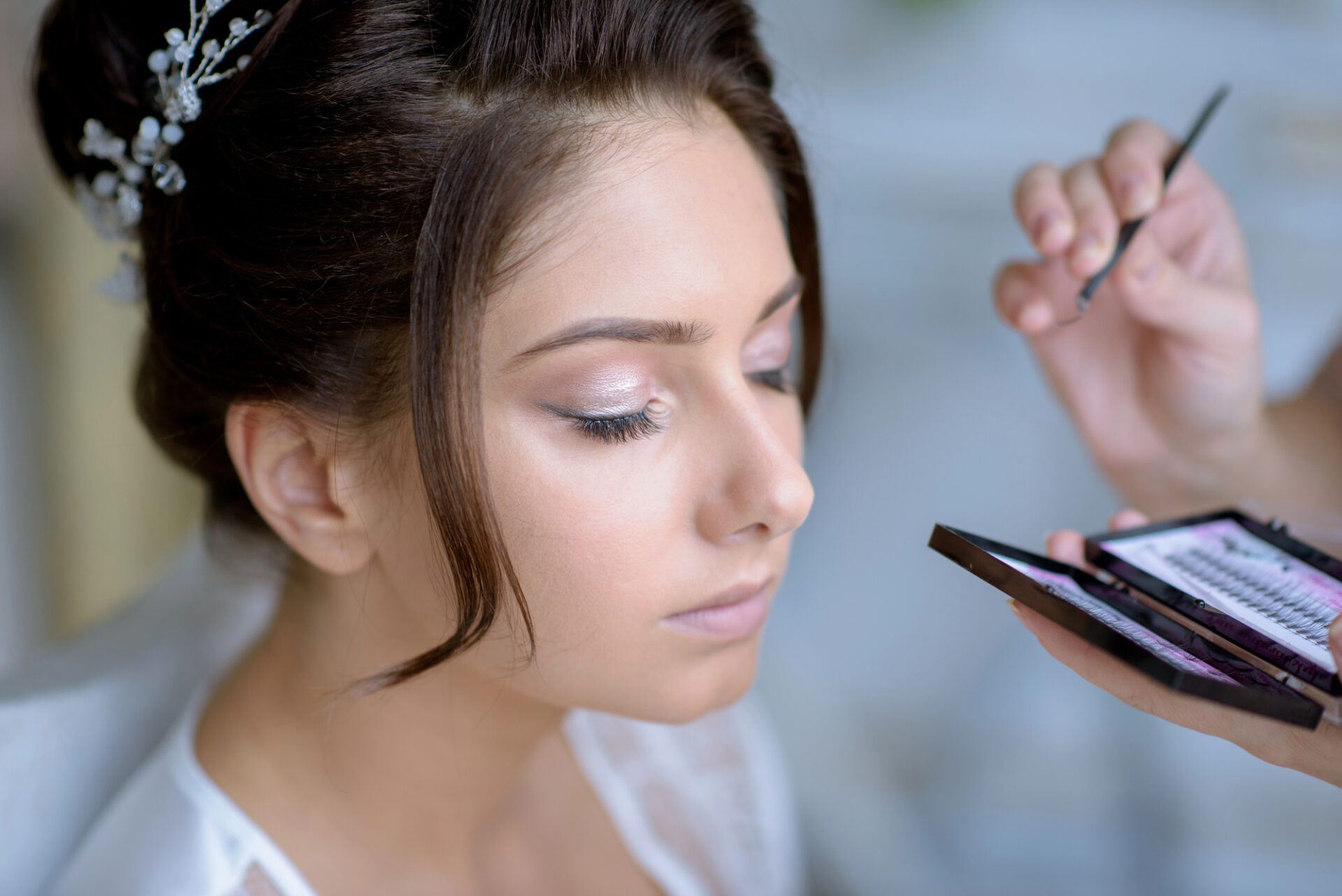
Here are the six most common mistakes that I correct beforehand… to guarantee beauty that’s just right, controlled and timeless.
Confusing the ideal image with skin reality
Visual references have become omnipresent.
But an image is not a face.
Filters, artificial lights, digital corrections… all work together to smooth skin, modify volumes and even out skin tones.
In professional make-up, however, I work with real texture: pores, relief, transparency of complexion.
Ignoring this reality creates unrealistic expectations – and a disappointing result.
The requirement is not to reproduce an image, but to interpret a balance.
Applying a trend without morphological reading
Makeup isn’t plastered on. It’s built in.
I often see brides arrive with a precise glow trend, graphic liner, nude mouth erased without considering their bone structure, their eyes, their natural pigmentation.
Successful make-up is based on analysis:
facial structure, volume placement, skin quality, eye intensity.
Without this reading, even the most elegant trend becomes unsuitable. This is a major technical error.
Overloading the material to “hold it together
It’s a mistake to think that more product guarantees better hold.
Excessive product makes make-up more fragile: it migrates, marks fine lines and loses its finesse in natural light.
I always prefer superimposing thin, transparent layers.
Hold comes from the precision of the textures, not their quantity.
Neglecting targeted skin preparation
Skin cannot be prepared uniformly.
Moisturize, yes, but how, where and with what texture?
T-zone, eye contour, oval of the face: each zone has its own needs.
A common mistake is to apply too rich or unsuitable skincare products, creating gaps in the make-up.
The complexion becomes unstable and uneven.
Preparation must be strategic, almost surgical.
Introducing new products without a test phase
Skin has a memory.
Changing foundation, base or skincare products a few days before the wedding introduces an uncontrollable variable:
skin reaction, oxidation, change in hold.
In a professional environment, nothing is left to chance.
Every product used on D-day must have been tested, observed and validated.
Underestimating environmental constraints
Light, humidity and temperature have a profound effect on rendering.
Make-up designed for a muffled interior does not react in the same way outdoors, at altitude or in humid heat.
As skin evolves, so do materials.
I always design make-up according to the context:
weather conditions, length of day, emotional intensity.
Dress is never a coincidence, it’s anticipated.
A successful beauty treatment is not noticeable. It’s obvious, without ever betraying the technique behind it.
And you, are you looking for make-up that shows… or make-up that reveals you, without ever being noticed?


